Drones and VTOL
Power for propulsion and payload where space is tight.
We develop the complete electrical and electronic architecture for drones, robots and unmanned vehicles, from concept to tested prototype.
Sized for each current rating
Conductor material, cross-section and insulation material are sized for each current class, temperature and voltage. Studs with defined tightening torque, vibration-proof mounting.

Voltage levels · topology · interfaces
Voltage levels, distribution and interfaces are matched to your system, from the main battery to the loads.

Hazards · risk · safety functions
Hazards are identified, assessed and turned into safety functions with requirements, according to IEC 61508.

For a remote-controlled ground vehicle, we designed, built and commissioned the entire E/E architecture.
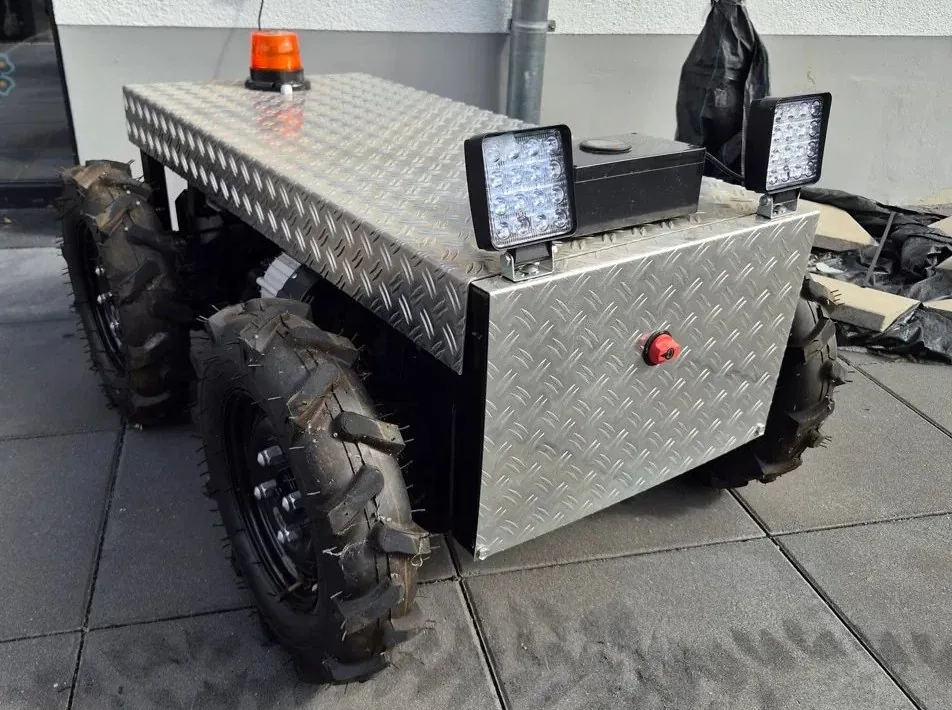
Mobile robots, automated guided vehicles and autonomous systems will grow strongly in the coming years. Their backbone is a mobile, battery-electric power supply in the low-voltage range up to 60 V DC, and that needs robust, safe power distribution. The challenge: components from different manufacturers each come with their own supply requirements, so custom distribution boards tailored to the specific robot are often needed. Bilalp already has solid know-how and practical experience in this field and develops flexible power distribution boards and E/E architectures in industrial quality. Instead of rigidly wired off-the-shelf systems or boards redeveloped from scratch each time, Bilalp relies on modular components: channel count, fusing and connectors can be adapted to any system, and the concept stays uniform across all power classes up to 60 V. Customers get an individual solution made from proven building blocks, shorten their development time and reduce the effort for one-off builds. At Bilalp, product and engineering come from a single source, using functional safety methods according to IEC 61508.
Tell us about voltage, power and application. We will get back to you with a proposal.